
Case IH 535 Steiger Intermittent RPM Drop
Case IH 535 Steiger Intermittent RPM Drop Causing Transmission to Kick Out of Gear
Intermittent engine issues in modern agricultural equipment can create problems far beyond the engine itself. In this case, a Case IH 535 Steiger was experiencing a split-second RPM drop that not only affected engine performance—but would occasionally cause the transmission to kick out of gear.
These types of symptoms are difficult to diagnose, rarely consistent, and often don’t generate fault codes. Through disciplined diagnostics and a strong parts-and-service partnership between Melchert Equipment and Greater AG Parts, the root cause was identified and corrected.
The Symptoms: RPM Drop Leading to Transmission Disengagement
The operator reported a momentary engine RPM drop that would occur randomly during operation. When the RPM dipped, the tractor would sometimes:
-
Momentarily lose power
-
Kick out of gear at the transmission
-
Immediately recover as RPM returned
On high-horsepower articulated tractors like the Case IH 535 Steiger, engine speed stability is critical. Even a brief loss of RPM can interrupt communication between engine and transmission control systems, leading to driveline disengagement.
Initial Diagnostics: Addressing Common RPM and Electrical Causes
Because RPM signal stability plays a major role in both engine and transmission operation, diagnostics focused on electrical inputs and power supply integrity.
We inspected wiring and verified connections. Based on the symptoms, several common failure points were addressed:
✔ Alternator Replacement
Voltage fluctuations can disrupt engine and transmission control modules. Replacing the alternator eliminated charging system instability as a potential cause.
✔ Crankshaft Position Sensor
This sensor provides real-time engine position and RPM data to the ECM. Signal interruption can cause momentary RPM loss.
✔ Engine Speed Sensor
Another critical input used by the ECM to regulate fueling, timing, and communication with the transmission controller.
Each component tested logically for the symptoms observed—but the intermittent RPM drop and occasional transmission kick-out remained.
When Sensors Test Good: Evaluating the Engine Control Module (ECM)
With clean wiring, stable voltage, and verified sensor inputs, attention turned to the Engine Control Module (ECM).
ECM-related failures can be difficult to detect because:
-
They may not set diagnostic trouble codes
-
Failures can be internal and intermittent
-
Symptoms can appear across multiple systems, including the transmission
In this case, the ECM was intermittently dropping RPM signal integrity, which caused the transmission control system to interpret the event as an unsafe operating condition—leading to disengagement.
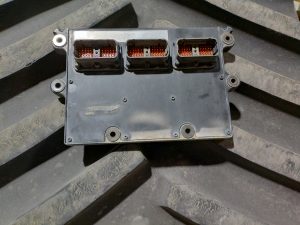
The engine control module (ECM) identified as the root cause of intermittent RPM drop and transmission disengagement on this Case IH 535 Steiger.
The Root Cause Identified: ECM Failure
After replacing and properly programming the ECM, the results were immediate and conclusive:
✅ RPM stabilized completely
✅ Transmission remained engaged
✅ No additional fault codes
The intermittent RPM drop—and the transmission kick-out—were fully resolved.
Why This Matters in Modern Case IH Steiger Tractors
This Case IH 535 Steiger repair highlights several important realities of today’s electronically controlled ag equipment:
-
Engine RPM stability directly affects transmission operation
-
Intermittent ECM failures can mimic sensor or mechanical issues
-
Not all failures generate fault codes
-
Accurate diagnostics prevent unnecessary downtime and expense
When engine and transmission systems are closely integrated, even a split-second event can create major drivability concerns.